Posted on 5/16/26 by Chris Blair
Thomas Aquinas: Cosmological Argument for GOD (Longform Article)
Introduction
Who is God and what is the proof? This conversation has only become increasingly complex through the millenniums to include abstract ideas, metaphysics, experiential observation, a priori logic, biology, physics, and theoretical physics. Although there are seemingly innumerous arguments for and against God, Thomas Aquinas has developed a cosmological argument that is still relevant today. Thomas Aquinas’ first three of his “Five Ways” constitute a cosmological argument for God’s existence, are independent of restraints from an infinite or finite universe and provide a metaphysical framework that continued into the Enlightenment Era; Despite critiques of his metaphysical logic by Enlightenment philosophers, Aquinas’ cosmological argument finds regeneration in contemporary theological defenses.
Thomas Aquinas: Cosmological Argument within the Five Ways
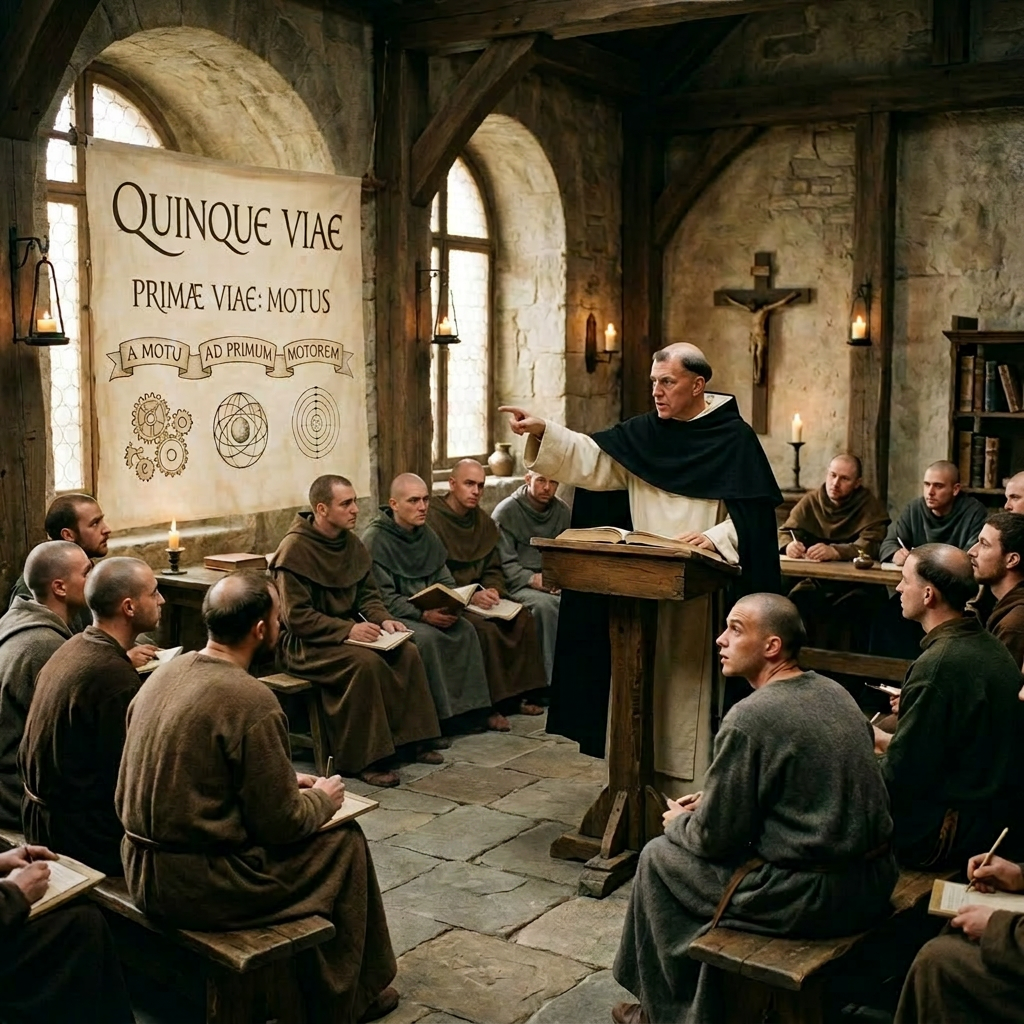
Thomas Auinas’ “First Way”, also known as the Argument from Motion, states the existence of a “First Mover” is a logical necessity derived from the observable reality of change.[1] Aquinas argues that God is the “First Mover”. Change in our world and in our universe is obvious to all who observe. Things are in a constant state of flux moving from states of potentiality to states of actuality. These changes are neither spontaneous nor causeless. Aquinas argues that each potentiality must be caused by a previous actuality. But what does that mean? If there is something that has the potential to produce thermal energy, like Kerosene, there would need to be something that has already actualized thermal energy to ignite Kerosene to be actualized in producing flames. The Kerosene could not be both actualized in producing thermal energy and, at the same time, be in a cold state as potential thermal energy. Therefore, “whatever changes must be changed by something else. If what causes change is itself changing, then this also must be changed by something else… This cannot go on indefinitely, since then there would be no first cause of change”[2]
Thomas Aquinas’ “Second Way” changes from the concept of motion to the concept of existence.[3] He argues that all effects are part of a chain of causes and effects that can be traced back to a singular uncaused cause, a “First Cause”, that has no preceding cause. Aquinas reasons that God is the logical “First Efficient Cause” that possesses the power of existence within Himself. Aquinas explains in the world, there is a clear “order of efficient causes”, a chain where one thing brings about another. It would be a logical contradiction for anything to be the efficient cause of itself, because it would require it to exist prior to existing; It would have to exist and not exist at the same time and in the same way.[4] Consider a water molecule (H2O) as an effect. Its existence depends on the chemical bonds that hold hydrogen and oxygen together; those bonds depend on the behavior of subatomic particles; those particles depend on the fundamental laws of physics. This modern illustration of a causal chain shows how multiple levels of intermediate causes are required to exist simultaneously for the water molecule to exist in reality. No matter how many intermediate causes are inserted, like atoms, quarks, fields, or laws, none of them could be self-caused or sufficiently explain why the causal structure exists and operates at all. Aquinas argues that “to take away the cause is to take away the effect; therefore, if there were no first cause among efficient causes, there would be no last cause, nor any intermediate cause.”[5] By his logic, if you removed God as the first cause, no chain of causes would even exist, meaning nothing could exist.
Thomas Aquinas’ “Third Way” changes from the essential cause to the concept of possibility and necessity. Aquinas states, “The third way is taken from possibility and necessity, and runs thus. We find in nature things that are possible to be and not to be, since they are found to be generated, and to corrupt, and consequently, they are possible to be and not to be.”[6] Aquinas is referring to contingent objects, plants, and people that are “generated” and eventually “corrupt[ed]”. Because these things have a beginning and end, they have no guarantee to exist. Contingent beings do not contain the reason for their existence within themselves. Aquinas argues that if everything were contingent in this way, then there would be a point at which nothing existed at all;
“So if at one time nothing was in existence, it would have been impossible for anything to have begun to exist, and thus even now nothing would exist—which is obviously false. Therefore, not all beings are merely possible; there must be something with necessary existence.”[7]
Therefore, the universe requires a necessary being that is not contingent on anything else; everything in the universe is ultimately contingent on the being we know as God.
Thomas Aquinas: Medieval Reception
Thomas Aquinas was influenced by two major intellectual streams while studying at the University of Naples and the University of Paris between 1239 A.D. and 1256 A.D.; the writings of Aristotle and the works of the Islamic philosophers who had continued upon previous Greek ideas of thought.[8] Aristotle, who lived around 1,500 years before Aquinas, emphasized empirical observation, logic, causality, and natural philosophy. Aquinas would later use Aristotle’s principles to argue that human reason could discern certain truths about the world, grounding many of these principles in his “Five Ways”. Key Islamic philosophers studied by Aquinas were figures like Avicenna and Averroes who preserved Aristotle’s works and provided extensive commentaries, integrating Aristotelian reasoning with Islamic theological principles.[9] For example: metaphysical distinctions between essence and existence, later used by Aquinas, were inspired by the works of Avicenna.
As Thomas Aquinas’ “Five Ways” was introduced to the medieval conversation, Siger of Brabant directly challenges Aquinas’ “Second Way” by rejecting the core assumption that an essentially ordered series of efficient causes could not regress infinitely. Siger argues that the world and motion are eternal, he sees no contradiction in an infinite hierarchy of causes that do not rely on a “First Cause.” Siger writes;
“For, what is composed of things finite in quantity yet infinite in number has to be infinite. So also, although there is no individual man but that he has begun to exist when he had not existed before, yet there is an individual before the individual to infinity; it is thus that man does not begin to be when he had in no wise existed before, and neither does time… Therefore, it must be concluded that it is reasonable that man has come into existence in some determined individual. Indeed, the human species comes and came into being accidentally by the generation of individual before individual to infinity.”[10]
Aquinas replies to this type of argument, in Summa Contra Gentiles: Book Two, by clarifying the difference between accidentally ordered causal series and essentially ordered causal series; “thus, it is accidental to Socrates’ father that he is another man’s son or not. But it is not accidental to the stick, in moving the stone, that it be moved by the hand; for the stick moves just so far as it is moved.”[11] Where accidental causal series, like a person begetting another person, can extend infinitely into the past on principle; an essentially ordered causal series is the metaphysical here-and-now dependence of causal activity. Aquinas’ analogy of a hand moving a stick, moving a rock, that moves a leaf is a primary example of how his “First Way” and “Second Way” are not bound by a temporal finitude; it is the essential causal chain that cannot regress infinitely.[12]
On the other side of the argument, Saint Bonaventure criticizes Aquinas’ acceptance of an infinite regress of accidental causal series, which implies the plausibility of an infinite universe in time. Bonaventure states numerous cases against the logic of temporal infinite, one case being, “It is impossible to transverse what is infinite. But if the world had no beginning, there has been an infinite number of revolutions; therefore it was impossible for it to have transversed them; therefore impossible for it to have come down to the present.”[13] Bonaventure believed the very idea of an eternal chain contradicts reason and argued that creation in time can be philosophically proven. Aquinas’ continued answer to this argument is; “the newness of the world is known only by revelation; and therefore it cannot be proved demonstratively.”[14] This foundational belief is why Aquinas’ cosmological argument does not depend on temporal succession, therefore whether the universe in infinite or finite, the “Five Ways” still stand.
Thomas Aquinas: The Critique of Enlightenment
Enlightenment Thinkers like David Hume, Immanuel Kant, and Pierre Bayle challenged the metaphysical logic behind Thomas Aquinas’ cosmological argument found in his “Five Ways”. David Hume, in his book An Enquiry Concerning Human Understanding, stated “every effect is a distinct event from its cause. It could not, therefore, be discovered in the cause, and the first invention or conception of it, a priori, must be entirely arbitrary.”[15] Hume illustrates this with his billiard-ball example: simply observing a billiard ball doesn’t logically “reveal” motion, nor does the motion of the first ball guarantee any necessary motion in the second. He describes one billiard ball in motion heading toward a second billiard ball. He describes many variations of the first ball swerving out of the way of the second or the first ball stopping when striking the second and “therefore, should we pretend to determine any single event, or infer any cause or effect, without the assistance of observation and experience.”[16] When Hume argues that because a cause and its effects are “distinct events”, one cannot find the effect just by analyzing the cause in the mind. Hume rejects the idea that reason alone can move from an observed effect to a necessary cause, challenging Aquinas’ cosmological argument that relies on a priori deductions from an effect back to a specific “First Cause”. By Hume’s logic, since cause and effect cannot be known by pure reason, then assigning God as the First Cause would be an arbitrary inference.
In Immanuel Kant’s book, Critique of Pure Reason, he makes the argument that there is no logical reason to require a “necessary being”. Kant states;
“It was believed that this had been found in the idea of a most real being, and this was therefore used only to provide more determinate acquaintance with something of which one was already convinced or persuaded on other grounds that it must exist, namely, the necessary being.”[17]
Kant describes that our minds are hardwired to look for causes, but the search has no logical stopping point. He then argues that the “necessary being” is a requirement of our own logic, not necessarily a reality of the universe.[18] Kant further argues that cosmological arguments, such as Aquinas’ “Third Way”, attempt to avoid becoming an argument from pure logic, by starting with something real; the fact that the world exists. Then use the state of real existence to reason a “Necessary Being”. Kant then argues that for a “necessary being” to exist, it must be the most perfect possible thing, the “ens realissimum”, and follows by saying, “I have to be able to infer conversely that what ever thing this concept… pertains to, that thing is absolutely necessary; and if I cannot so infer (as I must admit, if I want to avoid the ontological proof).”[19] Kant reasons that the cosmological argument of a “necessary being” is not only logically unnecessary, it is not a true cosmological argument. Kant states that it is “promising to put us on a new footpath” by starting with real existence but ends up “bringing us once again back to the old one”, being the ontological argument of pure reason.[20]
In the 1710 English edition of Pierre Bayle’s An Historical and Critical Dictionary, specifically in article “Manicheans” remark (D), Bayle argues the metaphysical leap of identifying the “Necessary and Eternal” being as the “Infinite, Almighty, and endowed with all kind of Perfection” God of the Bible.[21] Bayle then sets up the case that shared observation shows us polar forces at work throughout the world; suggesting there is a better logical case based on experience, to believe in two necessary beings rather than one. David Hume continues this line of thinking in his book Dialogues Concerning Natural Religion. Hume makes the argument that there is no basis to attribute the “Perfect” Christian God to any “First Cause”; “For, as the cause ought only to be proportioned to the effect, and the effect, so far as it falls under our cognisance, is not infinite; what pretensions have we, upon your suppositions, to ascribe that attribute to the Divine Being?”[22] He uses the analogy of surveying a ship and looking at the architecture, craftsmanship, and beauty only to discover it was made by a “stupid mechanic” that just copied someone else. By Hume’s logic, how can we pretend to attribute anything to the source of the universe just by the limited observation we can make?
Thomas Aquinas: Modern Defense
As Edward Feser notes, in his book Aquinas, modern philosophy was significantly influenced by Descartes, Locke, Hume, Kant and others. Although “most contemporary philosophers would probably not identify themselves as Cartesians, Lockeans, Humeans, Kantians, or the like, their thinking about metaphysical concepts” are often “confined within the narrow boundaries set by these early modern thinkers.”[23] Feser further explains that this causes a misunderstanding of the original meaning of Aquinas’ metaphysics and leads to a distortion of his arguments. As “causes and effects are, in Hume’s words, ‘loose and separate,’ with no ‘necessary connection’ holding between them”,[24] it shows that Hume has missed the idea completely. When Hume uses the billiard ball analogy, he uses a different definition of what a “cause” is. Hume defines a cause as the event of a billiard ball moving toward another and makes the cause and effect separate; because as the billiard ball is moving through time, toward another billiard ball, a logical effect may fail. According to Feser, what Aquinas actually said; “it is things that are causes, not events; and the immediate efficient cause of an effect is simultaneous with it, not temporally prior to it.” By Aquinas’ logic, it is not plausible for effects and causes to be separate and without connection.[25]
According to Immanual Kant’s argument, “the principle of causality applies only to the world of sensory experience and cannot take us beyond it to a transcendent first cause.”[26] The major problem with Kant’s argument is that it’s not self-evident. A similar argument could be made that love is not real. Love is just the human mind being hardwired to look for a necessary connection between people; but that wouldn’t mean the bond between two people doesn’t exist objectively. By Kant’s logic, we could be correctly perceiving a real, objective necessity while he dismisses it as a mere “mental filter.” Maurice Holloway continues this argument, “from the fact that our knowledge of the principle of causality derives from our experience of sensible things…,it simply doesn’t follow that it cannot be applied beyond the realm of sensory experience.”[27] The direct counter to Kant’s argument is that the metaphysical principles do not apply to things because they can be sensed, it applies to things because they exist. Kant’s further critique of Aquinas’ “Third Way” becoming an argument from pure logic ignores the actual concept Aquinas was arguing. Aquinas was not saying that God is a logically “necessary being”, as in something whose contradiction is inconceivable, God is a factually “necessary being” because he is the ultimate base of all other existence. Edward Feser explains, “Something that always exists would by that very fact show that it is something whose nature does not include any inherent tendency towards corruption, and thus that it is necessary.”[28]
To answer Kant’s critique that cosmological arguments are a circular path back to the ontological argument, we need only look at modern metaphysics for the answer. As Brian Ellis states in his book, The Metaphysics of Scientific Realism, “Consequently, the causal dimensions of things are ontologi-cally dependent on the categorical ones. Therefore, things must have both categorical and the causal dimensions, if their existence is to be both possible and knowable.”[29] Ellis’ account of dispositional and categorical properties being intrinsically linked undermines Kant’s claim that moving from “real existence” to a “necessary being” involves a leap in logic. If causal explanation is grounded in the very nature of things, rather than in conceptual inference alone, the cosmological argument does not rely on the ontological argument’s purely logical necessity; instead, it is rooted in the metaphysical structure of reality itself.[30]
Pierre Bayle supports his argument of the higher probability of there being at least two necessary beings with his observation of dualities. Bayle describes hot vs cold, good vs evil, regeneration vs decay.[31] The glaring flaw in Bayle’s argument is his examples are not actually showing two opposing forces. A basic understanding of thermodynamics will reveal that there is no such force as cold. Cold is merely the absence of heat; absolute zero being a complete absence of the force of heat. In the same way, it could be argued that evil is not a force; evil is the absence of the force of good. An act of absolute evil is one in which is completely devoid of the goodness of God. In the same way, it could be argued that decay is not an opposing force of regeneration; decay is merely the lack of regeneration. Regeneration would be the only force and when it is lacking the result is decay. Using the example of thermodynamics as a logical base, it could be argued that the natural state of everything we can observe is a state of stasis and taken further, non-existence. The only means of existence for anything would need to be a positive force outside of itself. This observation, counter to Bayle’s suggested “common experience”, directly aligns with Thomas Aquinas’ cosmological argument. Thus requiring the existence of a necessary being that is not contingent on anything else; everything in the universe is ultimately contingent on the being we know as God.
Aquinas can answer Hume on his own terms. Hume’s ship-survey analogy[32] only works if the “cause” of the universe is imagined as one craftsman among many, as he would need someone to copy from. This would make the craftsmen an intermediary cause whose skill must be inferred from the quality of the product. But Aquinas’s “Second Way” is not reasoning from an observed artifact to the character of its artisan; as in, it is not a teleological argument of design. It argues from the existence of contingent, essentially ordered causes to the necessity of a “First Cause”. The properties of a “First Cause” and “necessary being” are metaphysical necessities, not observed traits.[33] To use a similar themed analogy; it was as if Hume was inspecting a sea vessel created by Aquinas. He remarked that it was too small, only having a deck that was eight by six feet. The railings of the deck were too low; any sailor would fall off with ease. There were no sails; it had no visible means of locomotion. There is no way it could make it across the unforgiving ocean. However, what Hume was looking at was not a boat, it was the Bridge Fin of a submarine. Aquinas’ nuclear-powered undersea vessel was just a few feet below what Hume surveyed.
Conclusion
Aquinas’ metaphysical argument for the necessity of God can only be understood on its own terms, not through the conceptual filters imposed by early-modern philosophy. When philosophers like Hume, Kant, and Bayle redefine causation as a temporal sequence of discrete events in a horizontal order, they can only misunderstand arguments that presuppose causes as temporally simultaneous with effects in a vertical order. Aquinas is not making any metaphysical leaps in logic, he is explaining a clear metaphysical ladder to the source of everything; a perfect, all powerful, essentially necessary God.
[1] Thomas Aquinas, Summa Theologica (Anboco, 2016), I, q. 2, a. 3.
[2] Frederick Christian Bauerschmidt, The Essential Summa Theologiae: A Reader and Commentary (Grand Rapids, MI: Baker Academic, 2021), 56-57.
[3] Thomas Aquinas, Summa Theologica (Anboco, 2016), I, q. 2, a. 3.
[4] Thomas Aquinas, Summa Theologica (Anboco, 2016), I, q. 2, a. 3.
[5] Frederick Christian Bauerschmidt, The Essential Summa Theologiae: A Reader and Commentary (Grand Rapids, MI: Baker Academic, 2021), 56-57.
[6] Thomas Aquinas, Summa Theologica (Anboco, 2016), I, q. 2, a. 3.
[7] Bauerschmidt, The Essential Summa Theologiae, 57–58.
[8] Brian Davies, ed., Thomas Aquinas: Contemporary Philosophical Perspectives (Oxford: Oxford University Press, 2002), 5–6.
[9] Julius R. Weinberg, “Philosophy in the Islamic Middle Ages,” in A Short History of Medieval Philosophy (Princeton, NJ: Princeton University Press, 1964), 107–132.
[10] Siger of Brabant, De Aeternitate Mundi, in Medieval Philosophical Texts in Translation, no. 16 (Milwaukee: Marquette University Press, 1964), 87.
[11] Thomas Aquinas, “Arguments by Which Some Try to Show That the World Is Not Eternal,” in Summa Contra Gentiles: Book Two: Creation, trans. James F. Anderson (Notre Dame, IN: University of Notre Dame Press, 1956).
[12] Thomas Aquinas, Summa Theologica (Anboco, 2016), I, q. 2, a. 3.
[13] Bonaventure, On the Eternity of the World, in The Eternity of the World, trans. and ed. Armand A. Maurer (Milwaukee: Marquette University Press, 1964), II Sent., d. 1, p. 1, a. 1, q. 2.
[14] Thomas Aquinas, Summa Theologica (Anboco, 2016), I, q. 46, a. 2.
[15] David Hume, An Enquiry Concerning Human Understanding (Electric Book, 2019), 29, ProQuest Ebook Central.
[16]David Hume, An Enquiry Concerning Human Understanding (Electric Book, 2019), 29, ProQuest Ebook Central.
[17] Immanuel Kant, Critique of Pure Reason, ed. Paul Guyer and Allen W. Wood (Cambridge: Cambridge University Press, 2025), 533-35.
[18] Kant, Critique of Pure Reason, 538–39.
[19] Immanuel Kant, Critique of Pure Reason, ed. Paul Guyer and Allen W. Wood (Cambridge: Cambridge University Press, 2025), 537.
[20] Kant, Critique of Pure Reason, 536.
[21] Pierre Bayle, An Historical and Critical Dictionary. By Monsieur Bayle. Translated into English, with Many Additions and Corrections, Made by the Author Himself, That Are Not in the French Editions… A–B, vol. 3 (London: C. Harper, D. Brown, J. Tonson, A. and J. Churchill, T. Horne, T. Goodwin, R. Knaplock, J. Taylor, A. Bell, B. Tooke, D. Midwinter, B. Lintott, and W. Lewis, 1710), 628-30.
[22] David Hume, Dialogues Concerning Natural Religion (Andrews UK Ltd., 1980), 40–41, ProQuest Ebook Central.
[23] Edward Feser, Aquinas: A Beginner’s Guide (Oxford: Oneworld Publications, 2011), sec. 2, “Metaphysics.”
[24] Feser, Aquinas, sec. 2, “Four Causes.”
[25] Feser, Aquinas, sec. 2, “Four Causes.”
[26] Edward Feser, Aquinas: A Beginner’s Guide (Oxford: Oneworld Publications, 2011), sec. 3, “Second Way.”
[27] Feser, Aquinas, sec. 3, “Second Way.”
[28] Feser, Aquinas, sec. 3, “Third Way.”
[29] Brian Ellis, The Metaphysics of Scientific Realism (Taylor & Francis Group, 2009), 85, ProQuest Ebook Central.
[30] Ellis, The Metaphysics of Scientific Realism, 86.
[31] Pierre Bayle, An Historical and Critical Dictionary. By Monsieur Bayle. Translated into English, with Many Additions and Corrections, Made by the Author Himself, That Are Not in the French Editions… A–B, vol. 3 (London: C. Harper, D. Brown, J. Tonson, A. and J. Churchill, T. Horne, T. Goodwin, R. Knaplock, J. Taylor, A. Bell, B. Tooke, D. Midwinter, B. Lintott, and W. Lewis, 1710), 628-30.
[32] David Hume, Dialogues Concerning Natural Religion (Andrews UK Ltd., 1980), 40–41, ProQuest Ebook Central.
[33] Thomas Aquinas, Summa Theologica (Anboco, 2016), I, q. 2, a. 3.
 BlairBibleBlog.org